
AI Agents Are Coming: Why the Next Technology Revolution Won’t Just Answer You — It Will Act for You

For the past few years, artificial intelligence has been moving from science fiction into everyday life.
We have seen AI generate images, write emails, create videos, summarize documents, write computer code and answer almost any question within seconds. Chatbots such as ChatGPT have introduced millions of people to a completely new way of interacting with technology.
But something much bigger is now emerging.
The next major evolution of AI may not be about better chatbots.
It may be about AI agents.
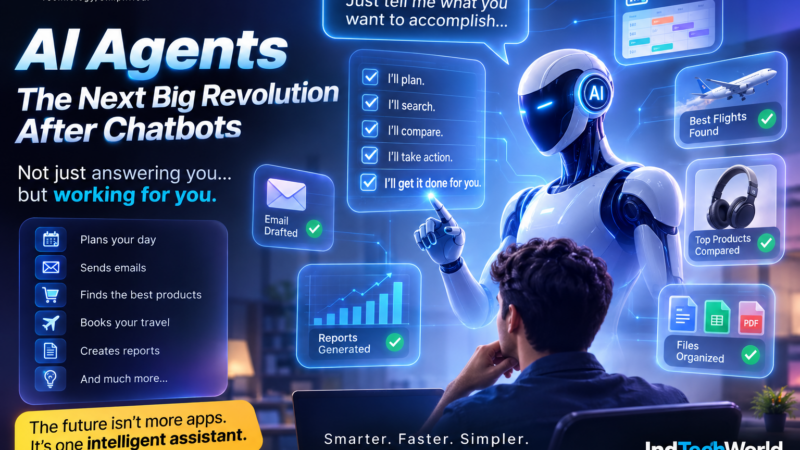
Instead of simply answering a question, an AI agent can potentially understand a goal, make a plan, use different digital tools and complete multiple steps on behalf of a person.
And that could fundamentally change how we use computers, smartphones and the internet.
What Exactly Is an AI Agent?
A traditional chatbot generally works like this:
You ask → AI answers → Conversation ends.
An AI agent aims to work differently:
You give it a goal → AI plans → AI uses tools → AI takes actions → AI reports the result.
Imagine telling your AI assistant:
“Find me a flight to Delhi next Friday, compare the options, check my calendar and suggest the best one.”
A traditional chatbot might give you instructions or search results.
An AI agent could potentially perform the entire workflow by interacting with calendars, travel websites, email and other services.
The important difference is action.
AI is moving from being something we talk to into something that can potentially work for us.
Your Smartphone Could Become More Intelligent
For more than a decade, smartphone companies have competed on processors, cameras, displays and battery life.
But the next major smartphone battle could be about something less visible:
How intelligent is your phone?
Today, we manually open applications to perform individual tasks.
We open WhatsApp to send a message.
We open Google Maps to find a location.
We open a browser to search for something.
We open a shopping app to compare products.
We open our calendar to check appointments.
Imagine if your phone could understand the bigger picture.
Instead of opening five different applications, you could simply say:
“I have a meeting in Bengaluru tomorrow at 11 AM. Find the best route, check when I should leave, add it to my calendar and remind me before I leave.”
The smartphone could become less like a collection of apps and more like a personal digital assistant.
That could completely change the way mobile technology evolves.
From Searching for Information to Getting Things Done
Search engines changed the internet because they made information easier to find.
Then smartphones made that information available everywhere.
AI could take the next step.
Instead of searching for information ourselves, we may increasingly ask AI to do something with that information.
Consider online shopping.
Today, a consumer might search for:
“Best wireless headphones under ₹5,000.”
Then they open multiple websites, compare specifications, read reviews and check prices.
An AI agent could potentially understand the requirements, compare suitable products, identify important differences and present a shortlist.
The same concept could apply to almost everything.
Planning a trip.
Finding a restaurant.
Preparing a presentation.
Organizing documents.
Researching a product.
Managing a schedule.
Writing reports.
The internet may gradually shift from a place where humans perform tasks manually into an environment where humans increasingly delegate tasks to software.
AI Agents Could Change the Workplace
The impact could be even bigger inside businesses.
Think about a sales employee.
A salesperson might spend hours every week updating CRM records, preparing reports, sending follow-up emails and checking customer information.
These tasks are important, but they don’t necessarily require constant human decision-making.
An AI agent could potentially handle parts of this workflow.
For example:
“Review this week’s sales data, identify customers who haven’t been contacted recently, prepare follow-up messages and create a priority list for tomorrow.”
The human still makes the final decisions.
But the amount of repetitive work could decrease dramatically.
This doesn’t necessarily mean that every job will disappear.
Instead, the definition of many jobs could change.
People may spend less time performing repetitive digital tasks and more time on relationships, creativity, strategy, negotiation and decision-making.
The Real Competition May Be Between AI Ecosystems
The AI race isn’t only about which company creates the smartest model.
The bigger battle could be about ecosystems.
Imagine an AI that can communicate with your phone, computer, email, calendar, banking applications, smart home devices and business software.
The company controlling that ecosystem could have enormous influence over how people interact with technology.
This is why companies across smartphones, operating systems, search, cloud computing and productivity software are investing heavily in AI.
The future may not be:
“Which app should I open?”
It could become:
“What do I want to accomplish?”
And the AI determines which tools need to be used.
But There Is a Big Problem: Trust
There is one major obstacle standing between AI agents and widespread adoption.
Trust.
Giving AI permission to answer a question is one thing.
Giving AI permission to send an email, purchase something, modify a document or make an important decision is completely different.
People will want to know:
- What exactly is the AI doing?
- Which information can it access?
- Who controls that information?
- Can the AI make mistakes?
- Can I undo its actions?
- Will companies use my data for advertising?
- What happens if an AI agent performs the wrong action?
These questions will become increasingly important.
The future of AI agents won’t depend only on intelligence.
It will depend on reliability, security, privacy and user control.
Humans Will Still Matter
There is a tendency to think that advanced AI means humans become unnecessary.
The reality could be more complicated.
Technology has repeatedly changed the way humans work.
Calculators didn’t eliminate mathematics.
Spreadsheets didn’t eliminate accountants.
The internet didn’t eliminate businesses.
Smartphones didn’t eliminate communication.
Instead, technology changed what humans were able to accomplish.
AI could do something similar.
A person who knows how to effectively use AI agents may eventually have an enormous productivity advantage over someone who performs the same digital tasks manually.
The valuable skill may therefore not simply be knowing how AI works.
It may be knowing how to work with AI.
The Future Could Be “Human + AI”
The most interesting future isn’t necessarily humans versus AI.
It could be:
Humans + AI.
Humans provide goals, judgment, creativity, experience and responsibility.
AI provides speed, analysis, automation and scale.
A small business owner could potentially use AI tools that previously required an entire team.
A student could have an intelligent research assistant.
A designer could generate and modify concepts much faster.
A developer could automate repetitive coding tasks.
A salesperson could spend more time talking to customers instead of updating spreadsheets.
A creator could research, write, edit and publish content faster.
The technology could give individuals capabilities that were previously available mainly to large companies.
The Biggest Change May Be Invisible
The most important technology revolutions aren’t always the ones with the flashiest hardware.
The internet changed the world without requiring people to understand how servers worked.
Cloud computing transformed businesses without most consumers thinking about data centers.
AI agents could follow the same pattern.
One day, people may simply use their phones and computers without thinking about whether an AI agent is operating behind the scenes.
You might ask your computer to organize your files.
Your phone might automatically prepare your day.
Your email system might prioritize important conversations.
Your shopping assistant might compare products.
Your business software might automatically prepare reports.
The technology could become almost invisible.
And that may be the point.
So, What Happens Next?
The AI revolution is still in its early stages.
Today’s AI systems are impressive, but they are not perfect. They can make mistakes, misunderstand instructions and sometimes produce unreliable information.
That means we shouldn’t blindly trust AI.
But we also shouldn’t underestimate where the technology is heading.
The transition from AI that answers questions to AI that can accomplish tasks could become one of the most important shifts in computing.
The smartphone changed how we communicate.
The internet changed how we access information.
Social media changed how we connect.
AI may change how we work with computers themselves.
And perhaps the biggest change will be surprisingly simple:
Instead of learning how to use dozens of different tools…
we may simply tell technology what we want done.
The future of technology might not be about having more apps.
It might be about needing fewer of them.
And the next generation of computers may not just be tools we operate.
They may become intelligent systems that work alongside us.
This is not the end of the technology revolution.
It could be the beginning of the most interesting part.
IndTechWorld Take
The biggest opportunity isn’t simply using AI to do the same things faster.
It’s discovering what becomes possible when humans no longer have to perform every digital step themselves.
The companies that build trustworthy AI agents will be important.
But the people who learn how to use them effectively could have an even bigger advantage.
The future isn’t AI replacing humans.
The future may be humans who know how to use AI better than everyone else.
IndTechWorld — Technology, Simplified.
